
How to Lose Weight Fast? The Honest Answer Most Guides Skip
You want the weight off. Not in six months. Now. I get it. The problem is that most “how to lose weight fast” articles either sell you a crash diet that rebounds in three weeks or bury the real answer under twelve paragraphs of throat-clearing. This guide does neither. It gives you the clinical reality from the CDC, NHS, and Cleveland Clinic, then shows you how to push the pace as hard as your body will safely allow without losing muscle or setting yourself up for regain. You will leave knowing exactly what “fast” actually means in pounds per week, which tactics move the needle fastest, and which popular shortcuts are a waste of your money.
The Real Speed Limit for How to Lose Weight Fast
The CDC is blunt about this: people who lose weight gradually, at about 1 to 2 pounds per week, are more likely to keep it off than people who lose it quicker. Cleveland Clinic’s clinical dietitian Beth Zumpano repeats the same range, noting that someone carrying more weight may see a bigger drop in the first week or two before it settles.
So when you ask how to lose weight fast, the honest answer is this: 1 to 2 pounds per week is fast. Anything beyond that is either water, glycogen, or muscle, and you will pay for it later. A 200-pound person dropping 2 pounds weekly is losing 1% of body weight per week. That is the ceiling before you start flirting with muscle catabolism and metabolic adaptation.
The first week will lie to you. If you cut carbs and sodium, the scale might drop 4 or 5 pounds by day seven. That is not fat. That is water bound to glycogen. It looks great in a text message to your friend. It means nothing for your waistline by week three.

Why “Fast” Fails Without a Protein and Resistance Anchor
Here is the part the crash-diet crowd never tells you. A calorie deficit always causes some muscle loss alongside fat. A 2025 study on alternate-day fasting found that participants lost an average of 2.4 kilograms of body mass, but also 0.8 kilograms of muscle, and whey protein supplements did not prevent that muscle decline.
Muscle is your metabolic engine. Lose it, and your maintenance calories drop. Your body then fights harder against the next deficit. That is how “fast” becomes “slow and miserable six weeks later.”
Two things protect you. First, protein. The Cleveland Clinic’s guidance specifically calls for adequate protein intake during weight loss to preserve lean mass. Aim for roughly 0.7 to 1 gram of protein per pound of your goal body weight, spread across meals. Second, resistance training. Even light resistance training signals your body that the muscle is needed. You do not need a gym. Bodyweight squats, push-ups, and resistance bands at home are enough to blunt the loss.
If you skip both, you are not losing weight fast. You are losing muscle fast.
The Three Levers That Actually Move Fast
Weight loss comes down to energy balance, but the levers you pull determine whether you are hungry and miserable or satisfied and consistent. These three are the ones with the strongest evidence behind them.
Lever One: A Deficit You Can Actually Tolerate
A 500 to 750 calorie daily deficit produces roughly 1 to 1.5 pounds of fat loss per week. That is arithmetic, not opinion. The CDC warns explicitly that setting unrealistic goals, such as losing 20 pounds in two weeks, leaves you feeling defeated and frustrated. Choose a deficit you can hold for eight weeks, not eight days.
The trap is going too low. Sub-1,200-calorie diets for women or sub-1,500 for men are hard to sustain nutritionally and accelerate muscle loss. If you feel dizzy, cold, or unable to complete a normal workout, your deficit is too aggressive.
Lever Two: Volume Eating Without Calorie Density
The CDC’s guidance on fruits and vegetables is not vague wellness advice. It is a mechanical trick: vegetables and fruits are high in water and fiber, which slows digestion and helps you feel full on fewer calories. You are not “adding healthy foods.” You are replacing calorie-dense foods with volume so your stomach signals fullness before you overshoot your deficit.
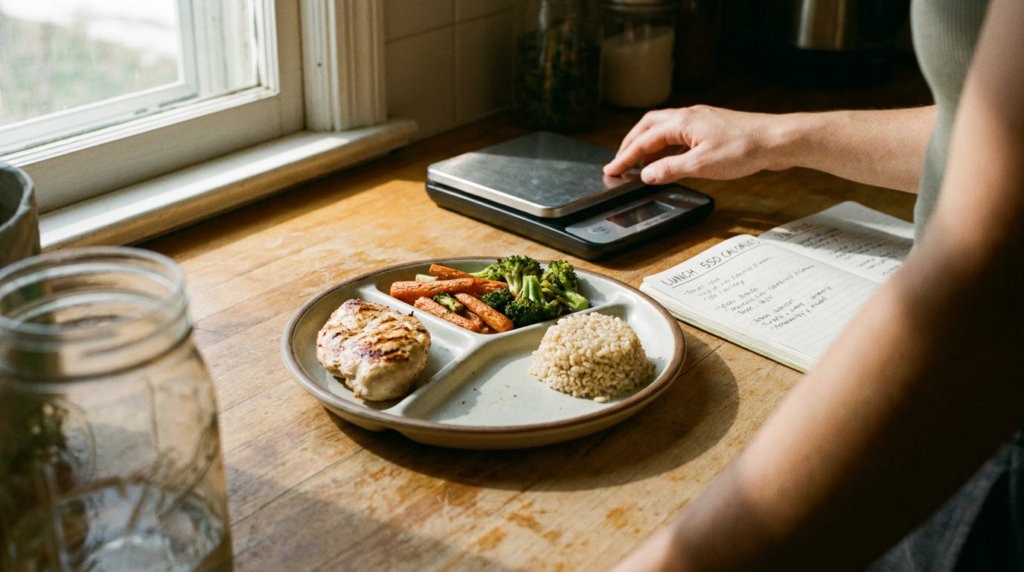
A practical swap: replace one cup of rice or pasta in your dinner with one cup of roasted broccoli or peppers. Same plate volume. Fewer calories. You eat the same amount of food by weight and feel equally full. Do this twice a day, and you have created a 200 to 300 calorie daily deficit without white-knuckling hunger.
Lever Three: Sleep and Stress, Not Just Salad
The CDC lists stress management and adequate sleep as core components of healthy weight loss alongside eating and activity. This is not filler. Short sleep raises ghrelin, the hunger hormone, and lowers leptin, the satiety hormone. You wake up hungrier and less satisfied by the same meal. A 2025 review of 99 randomized trials found that adherence, not diet type, was the strongest predictor of results across intermittent fasting and calorie restriction alike. You cannot adhere to anything when you are exhausted and stressed.
What About Intermittent Fasting for Speed?
Intermittent fasting has become the default “fast weight loss” recommendation on social media. The evidence is more boring than the hype. A systematic review of 99 randomized clinical trials involving more than 6,500 adults found that intermittent fasting and traditional calorie restriction produced similar weight loss. Only alternate-day fasting edged out calorie restriction by a trivial margin of nearly three pounds, a difference the researchers themselves described as not clinically meaningful.
Translation: if you prefer eating in a narrower window because it helps you control intake, use it. If you hate fasting, you are not missing a metabolic secret. The best diet is the one you can stick to, as Temple University obesity researcher David Sarwer noted in that review.
The GLP-1 Question: Medication as a Fast Track
You have seen the headlines. Ozempic. Wegovy. Zepbound. These drugs work by mimicking GLP-1, a gut hormone that signals fullness to your brain, slows stomach emptying, and reduces cravings. They produce weight loss that lifestyle changes alone rarely match.
But read the fine print. MedlinePlus states plainly that many people using GLP-1 agonists regain lost weight if they stop taking the medicine. The drugs are tools, not cures. They also carry side effects including nausea, vomiting, diarrhea, and reduced muscle mass. They are not a shortcut around the protein and resistance training problem. They make that problem more urgent because rapid weight loss on these drugs accelerates muscle loss if you are not protecting it.
If you are considering medication, that is a conversation with a physician who knows your history, not a decision from a blog post. The same goes for the newer triple agonists like retatrutide, which are still in clinical trials and not yet FDA-approved.
The Supplements That Do Not Work
MedlinePlus is uncharacteristically direct on this: many over-the-counter weight loss supplements do not work, and some can be dangerous. The FDA has warned against ingredients including ephedrine, BMPEA, DMBA, and tiratricol because of strokes, heart problems, and thyroid damage.
Green tea extract, African mango, chromium, and carnitine appear in countless “fast weight loss” products. The evidence for meaningful weight loss from these ingredients is weak or nonexistent. Your money is better spent on protein and vegetables.
https://healnurtura.com/do-weight-loss-supplements-really-work/
A Seven-Day Starter Protocol You Can Actually Follow
This is not a crash plan. It is the fastest safe on-ramp to the habits that produce 1 to 2 pounds of loss per week.
Days one and two: Calculate your maintenance calories using an online calculator, then subtract 500. Do not subtract 1,000. Track everything you eat in an app for these two days without changing anything. You need a baseline before you cut.
Days three and four: Add protein to breakfast and lunch. Eggs, Greek yogurt, chicken, tofu. The goal is 30 grams at each meal. Most people eat half that. Protein at breakfast specifically reduces evening hunger for many people.
Days five and six: Replace one starch portion per day with double the volume of vegetables. Not a salad as a side. Half the plate. Roasted, steamed, seasoned. You are testing whether volume eating works for your hunger.
Day seven: Do 20 minutes of resistance training. Bodyweight squats, push-ups from your knees, glute bridges, planks. This is the minimum effective dose to signal muscle preservation.
Weigh yourself on the morning of day one and day seven. Expect 1 to 2 pounds. If you see 5, it is water. If you see zero, your tracking was off, or your deficit was smaller than you thought. Adjust and repeat.
When to See a Doctor Before Trying to Lose Weight Fast
The CDC recommends talking with a healthcare provider if you have concerns about your weight or your medications. That is not a legal disclaimer to scroll past. Certain conditions make unsupervised rapid weight loss genuinely risky: type 2 diabetes on insulin or sulfonylureas, a history of eating disorders, pregnancy, and any condition affecting kidney or liver function.
If you are taking medication for blood pressure or diabetes, your doses may need adjustment as you lose weight. Do not guess.
Frequently Asked Questions
How fast can I lose weight safely?
1 to 2 pounds per week is the standard recommendation from both the CDC and Cleveland Clinic. People with more weight to lose may see faster initial drops, but the rate should settle into that range.
Does drinking water help you lose weight fast?
Water supports weight loss indirectly. Drinking water before meals can reduce your calorie intake by promoting fullness. Replacing sugary drinks with water eliminates liquid calories that do not trigger satiety. Water itself does not burn fat.
Is it better to lose weight fast or slow?
Slow and steady wins for sustainability. The CDC states directly that gradual loss is more likely to be maintained. Fast loss that comes from muscle and water rebounds. Fast loss that comes from a moderate deficit, high protein, and resistance training can be safe and sustainable.
Can I lose 10 pounds in a week?
Not safely from fat. A 10-pound drop in seven days would require a deficit of roughly 35,000 calories, which is impossible without starvation-level restriction that costs you muscle and water. Any product promising this is selling you dehydration or a lie.
Do weight loss supplements work?
MedlinePlus reports that most over-the-counter weight loss supplements lack evidence of effectiveness, and some contain dangerous ingredients the FDA has warned against. Whole foods, protein, and a calorie deficit are the evidence-backed approach.
How do I lose weight fast without losing muscle?
Two non-negotiables: adequate protein and resistance training. The Cleveland Clinic specifically recommends protein intake and light resistance training during weight loss to preserve muscle mass. A 2025 study confirmed that protein alone without exercise did not prevent muscle loss during rapid weight loss.
Conclusion on How to Lose Weight Fast
You can lose weight fast. You cannot lose it faster than your body can surrender fat without also surrendering muscle. The people who succeed at this are not the ones who white-knuckle a 1,000-calorie diet for ten days. They hold a moderate deficit, eat enough protein to protect their muscle, fill their plate with vegetables so they aren’t starving, and lift something heavy twice a week.
That is the entire secret. It is not glamorous. It works. If you want the next layer, the one about maintaining the loss and rebuilding your relationship with food after the deficit ends, that is what we cover in the HealNurtura newsletter. No crash plans. No supplement hype. Just the clinical evidence, stripped of the nonsense.