
How is peak expiratory pressure measured?
Peak expiratory pressure, more commonly called peak expiratory flow (PEF), is measured by having you take the deepest breath you can and then blow out as hard and as fast as possible into a handheld peak flow meter. The device records the fastest speed of that single forced exhale, displayed in liters per minute (L/min) . The highest of three attempts is your reading for that session.
That definition matters because the measurement is not about how much air your lungs hold. It is about how quickly air moves through your large airways when you push it. A narrow airway slows the speed of that push. The meter detects the slowdown before you feel short of breath .
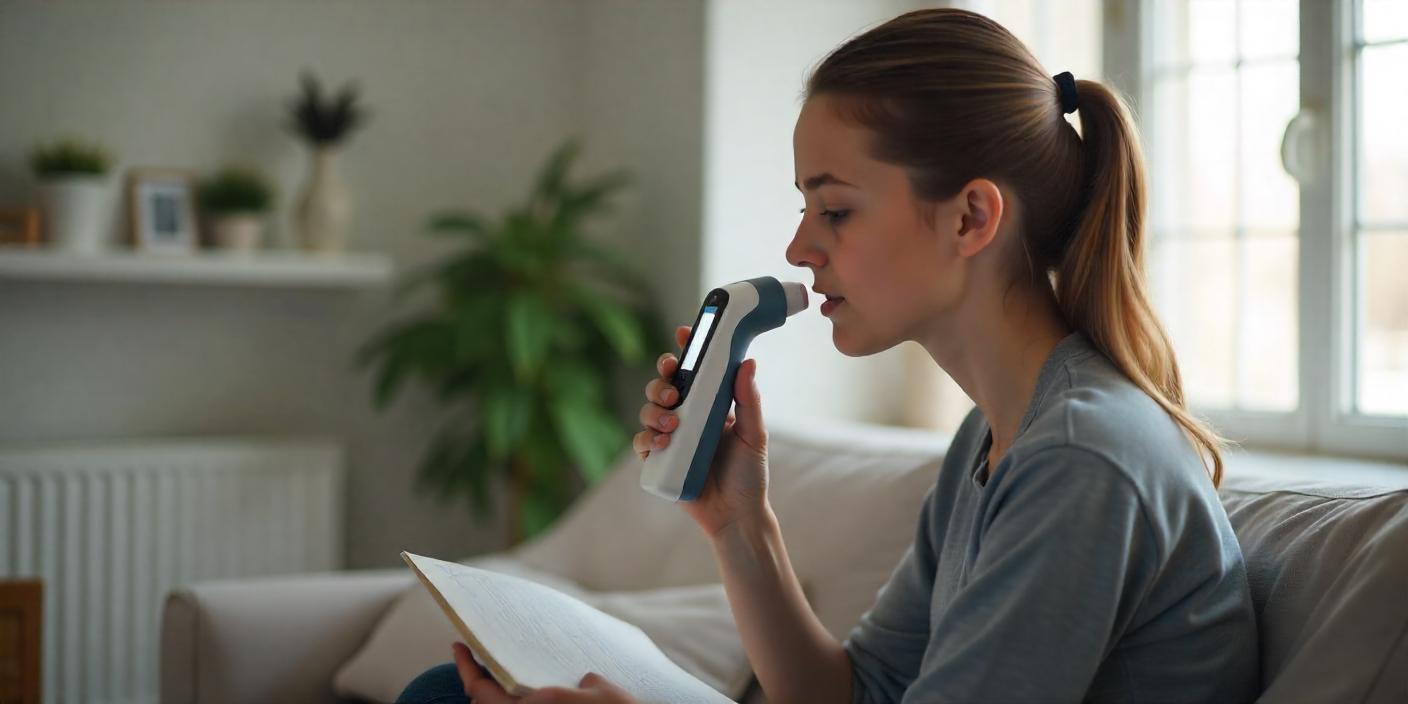
The device itself does less than you think
A peak flow meter is not a spirometer. It does not print a graph. It does not calculate your predicted value. It does not know your age, your height, or your medical history.
It is a tube with a spring-loaded piston and a sliding marker. When you blow, the piston moves and pushes the marker to a position. The marker stays there so you can read the number. That is the entire mechanism in a standard manual meter .
Digital meters exist and they store readings, which helps if you forget to write things down. But the underlying measurement principle is the same: speed of air through a fixed resistance, translated into liters per minute.
One consequence of this simplicity is that readings are not interchangeable between devices. A reading of 420 on one brand of meter may correspond to 390 on another. This is not a malfunction. It is why your personal best must be established on the same meter you use daily . If your clinic switches you to a different model, you need a fresh baseline.
The exact technique that produces a valid reading
Most bad peak flow data comes from technique errors, not from lung changes. The measurement only works if you treat it like a physical test with a defined procedure.
Reset the marker. Push the sliding indicator back to the bottom of the scale. On many meters, this is marked as 60 L/min, but follow the specific instructions printed on your device .
Stand up, unless standing is difficult. Standing gives your diaphragm more room to move. If you must sit, sit upright with your feet flat and your back supported. Do the same thing every time, because posture changes the number slightly .
Inhale completely, then seal your lips. Fill your lungs until your belly moves outward, not just your chest. Close your lips around the mouthpiece without leaving a gap at the corners. Air escaping around the mouthpiece lowers the reading without reflecting airway changes .
Blow once, as hard and fast as you can. Not a slow exhale. Not a two-second ramp-up. A single explosive push that empties your lungs as rapidly as possible. The meter is designed to capture the first fraction of a second, which is where the peak occurs.
Repeat three times and record the highest number. Rest briefly between attempts. Do not average the three readings. The highest value is the one that reflects your best effort and your most open airway at that moment .
A 2005 study in the journal Chest found that a brief pause of up to two seconds at full inhalation before you blow does not change the measured PEF in healthy adults . You do not need to rush the breath in and immediately blow. A short, controlled hold is fine.
What the number means, and what it does not
Your peak flow reading is compared to your personal best, not to a stranger’s number on a chart.
Personal best is the highest reading you can achieve over a two-week period when your asthma is well controlled and you have no symptoms. You establish it by testing twice daily, morning and evening, before taking any inhalers, for fourteen days. The single highest number from that period becomes your baseline .
Once you have that baseline, your readings fall into three zones:
Green (80 to 100 percent of personal best). Your airways are open. You can do normal activities and sleep without breathing trouble .
Yellow (50 to 80 percent). Airway narrowing is beginning. You may not feel it yet, but the meter has caught it. This is the window where adjusting medication or avoiding a trigger can prevent a full flare-up .
Red (below 50 percent). Severe narrowing. This is a medical emergency if you are struggling to breathe, walking is difficult, or your lips look blue. Call emergency services .
What the number does not tell you is why the airway is narrow. It could be inflammation, mucus, bronchospasm, or a combination. It also cannot distinguish between asthma and COPD on its own. It is a speed measurement, not a diagnosis.
The mistake that makes home monitoring useless
The most common failure in peak flow monitoring is not blowing hard enough. It is measuring inconsistently.
Peak flow varies through the day. It is typically lowest in the early morning and highest around midday. If you measure at 7 a.m. on Monday and 2 p.m. on Tuesday, the difference you see may reflect the clock, not your lungs .
Pick two fixed times. Morning and early evening is the standard recommendation. Test before you take your inhaler, or follow whatever schedule your clinician gave you. Write down the time alongside the number. A reading of 380 at 6 a.m. means something different from 380 at noon.
Consistency in posture, effort, and timing turns a meaningless scatter of numbers into a trend. And the trend is what matters. A single yellow-zone reading after a cold is expected. Three consecutive mornings in the yellow zone are a signal to act.
When the measurement is done in a clinic instead
Peak flow can also be measured with a spirometer during a pulmonary function test. The spirometer is a larger machine connected to a computer. It measures PEF as part of a fuller assessment that includes forced expiratory volume in one second (FEV1) and forced vital capacity (FVC) .
The clinic setting matters for diagnosis. Home peak flow meters are useful for monitoring a known condition, but they are not reliable enough on their own to diagnose asthma. If your doctor suspects asthma, spirometry before and after a bronchodilator gives a clearer picture of whether your airways are reversible .
For people with moderate to severe asthma, home peak flow monitoring and clinic spirometry work together. The clinic establishes the diagnosis and the big picture. The home meter catches the day-to-day drift that would otherwise go unnoticed until symptoms force a visit.
What to do when your reading drops
A drop in peak flow is information. It is not automatically an emergency, and it is not automatically nothing.
If your reading falls into the yellow zone and you have an asthma action plan, follow it. That plan was written for exactly this scenario. It may tell you to use a rescue inhaler, increase a controller medication temporarily, or contact your clinician. Do not improvise outside the plan if you have one .
If you do not have an action plan, a yellow-zone reading is a reason to call your clinician’s office. Describe the number, your symptoms, and when the drop started.
Red-zone readings are different. If you are below 50 percent of your personal best and you are struggling to speak, walk, or breathe comfortably, call emergency services. Do not wait to see if the next reading is better.
Frequently asked questions
What is a normal peak flow reading?
There is no single normal number. Peak flow depends on your age, height, sex, and ethnicity . A tall 30-year-old man and a short 60-year-old woman will have very different healthy values. The only meaningful comparison is your number against your own personal best. Charts exist, but they are population averages and should not be treated as targets.
Can I use a peak flow meter to diagnose asthma myself?
No. A low reading tells you that airflow is reduced. It cannot tell you why. Asthma, COPD, a respiratory infection, and even poor technique can all lower the number. Diagnosis requires spirometry and a clinical assessment . A home meter is a monitoring tool, not a diagnostic one.
How often should I measure my peak flow?
It depends on why you are measuring. If you are establishing your personal best, test twice daily for two weeks. If you are monitoring stable asthma, once daily or as directed is often enough. If your clinician is adjusting your treatment, you may be asked to test more frequently for a short period. The consistent timing matters more than the total count .
Why does my peak flow reading change between meters?
Different meter designs have different resistance and different scales. A reading from one brand is not directly comparable to a reading from another. This is why you should always use the same meter for your daily monitoring and establish your personal best on that specific device . If your meter breaks, establish a new baseline with the replacement.
Does peak flow measure how much air my lungs hold?
No. Peak flow measures speed, not volume. A person with large lungs and narrow airways can have a lower peak flow than a person with smaller lungs and open airways. Spirometry measures volume (FVC) and the volume exhaled in one second (FEV1), which gives a fuller picture of lung capacity and obstruction .
Medical Disclaimer: This article is for informational purposes only and does not constitute medical advice. Peak expiratory flow measurements should be interpreted in the context of your individual medical history and clinical guidance. Always consult a qualified healthcare provider before making decisions about asthma or COPD management, and seek emergency care for severe breathing difficulty.
We have recently launched a free tool to analyze your skin: HealNurtura Skin Analyzer
We’d love if you try and test it and share your experience through email contact@healnurtura.com or in the comment section below!