
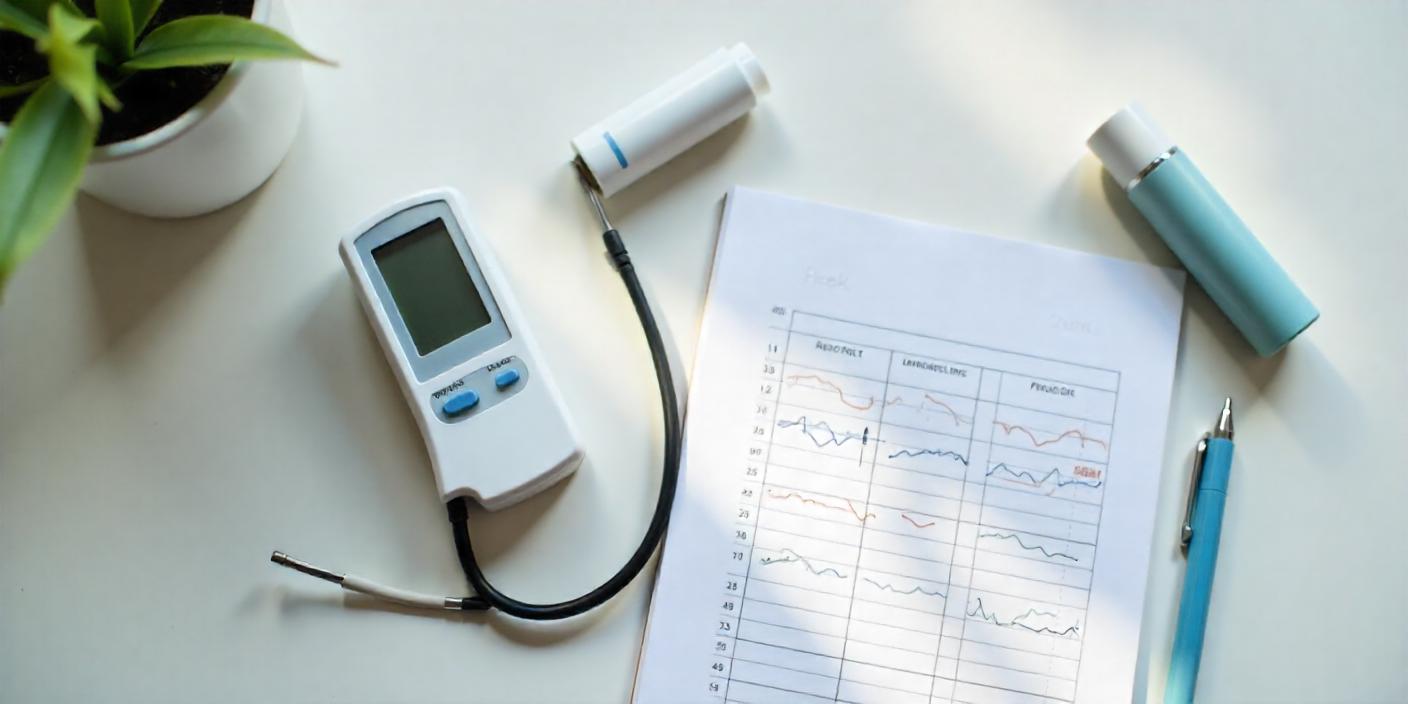
How Does Peak Expiratory Flow Work for Asthma?
You’ve probably been handed a little plastic tube with a sliding marker on the side and told to blow into it as hard as you can, three times, and write down the best number. Nobody usually explains why that number matters, or what’s actually happening in your lungs when you do it. So let’s actually get into it.
How does peak expiratory flow work for asthma, mechanically and clinically, and what do those green, yellow, and red zones on your chart actually mean for what you should do next? That’s what this piece walks through, with the real numbers behind it rather than a vague chart with no explanation attached.
How Does Peak Expiratory Flow Work for Asthma?
Peak expiratory flow, or PEF, measures the fastest speed of air you can force out of your lungs after taking as deep a breath as possible. In asthma, the airways narrow during a flare-up, which slows that airflow measurably before you’d necessarily feel short of breath.
A peak flow meter catches that narrowing early, giving you and your doctor a number to track instead of guessing from symptoms alone.
That’s the short version. Here’s what’s actually going on underneath it.
The Actual Physics Behind a Forceful Blow
A peak flow reading isn’t measuring your whole breath. It’s specifically catching the very first fraction of a second of a hard, fast exhale, the point where airflow peaks before it tapers off as your lungs empty.
That timing matters because of where narrowing happens in asthma. During an asthma flare, it’s mainly the larger, central airways, the trachea and bronchi, that constrict, and that early, effort-driven burst of air is exactly the part of the breath most sensitive to resistance in those larger passages.
According to StatPearls, a peer-reviewed clinical reference maintained through the National Library of Medicine, the reading depends on how deep your breath in was, how narrow your airways are, how much muscle force you generate, and genuine, maximal effort, all four factors combining into that single number on the scale.
This is also why technique matters so much more than people expect. A half-hearted blow into the meter doesn’t just give you a slightly lower number; it can look identical to real airway narrowing on paper, which is exactly why a clinician watching you use the meter for the first time matters more than most people realize.
Where “Normal” Numbers Actually Come From
Every peak flow chart floating around online traces back, directly or indirectly, to a 1989 study published in the BMJ by researchers A.J. Nunn and I. Gregg, which built regression equations predicting expected peak flow based on a person’s age, height, and sex.
Those equations are still the backbone of most peak flow meters sold today, including the ones with a printed reference scale down the side.
Worth knowing directly, since it rarely gets mentioned on product packaging: those original reference values were built from Caucasian populations, and predicted PEF can run meaningfully different across ethnic groups with different average chest and airway proportions. That’s part of why a generic printed chart matters less than the next section.
Why Your Personal Best Matters More Than Any Chart
A predicted number based on your age and height is a starting estimate, not a diagnosis. What clinicians actually use, and what StatPearls recommends establishing before building an asthma action plan, is your personal best, the highest peak flow reading you get while feeling completely well. The standard approach is measuring two to four times a day for about two weeks, always with the same meter, since readings vary between brands and can’t be reliably compared to each other. Whatever the single highest number turns out to be across that stretch becomes your baseline, and every zone on your action plan gets calculated as a percentage of that number, not of the generic chart value.
The Three Zones: Green, Yellow, Red
This is the part most people actually need day-to-day, and Johns Hopkins Medicine lays out how peak expiratory flow works in practice through three zones. Your green zone sits at 80 to 100 percent of your personal best, meaning your airways are open and you can go about normal activity without concern. Drop into the yellow zone, 50 to 80 percent of personal best, and it’s a caution signal: your larger airways are starting to narrow, and you may notice coughing, tightness, or feeling more tired than usual, even before it’s obvious enough to mention to anyone. That’s the window where contacting your provider about adjusting treatment actually prevents things from escalating. Below 50 percent puts you in the red zone, and both Hopkins and StatPearls describe this the same way: a medical emergency requiring immediate rescue treatment and a call to your provider or emergency services if breathing doesn’t improve right away.
For context on the numbers themselves, StatPearls notes that in adults younger than 65 without a documented personal best on hand, a reading below 200 liters per minute generally signals severe airway obstruction, which is the kind of number emergency staff use when someone arrives without their own baseline recorded.
How to Actually Use a Peak Expiratory Flow Meter
Getting a peak expiratory flow reading that means anything depends on doing this the same way every time. Stand up straight rather than sitting hunched over, since posture affects how much force you can generate. Slide the indicator down to zero before you start. Take the deepest breath you can manage, then seal your lips completely around the mouthpiece, keeping your tongue clear of the opening. Blow out as hard and as fast as you possibly can, a motion that should take no more than about two seconds, not a long, steady exhale. Note where the marker lands, reset it, and repeat the whole process two more times. Record only the single highest of the three numbers. Don’t average them. If you cough during any attempt, that reading doesn’t count, and you try again.
What Throws Off a Reading Without You Realizing It
A number that looks like worsening asthma isn’t always about your airways. StatPearls lists several things that quietly distort results: not breathing in fully before you start, not blowing out with full force, a poor seal around the mouthpiece, a dirty or clogged meter, and switching between different meter brands, since calibration varies enough between devices that comparing across them isn’t reliable.
Chest wall conditions, obesity, and general muscle weakness can also lower your number without any airway narrowing being involved at all, which is one more reason your own personal best matters more than a generic predicted value calculated from your height alone.
Building the Written Action Plan Around Your Numbers
A peak flow number by itself doesn’t do much. What actually changes outcomes is turning that number into a written asthma action plan, a specific, personalized document your provider creates with you that spells out what to do at each zone before you’re in the middle of a flare trying to remember.
StatPearls points to research showing that having a written action plan, built around either peak expiratory flow, symptoms, or both together, measurably reduces asthma-related complications compared to managing symptoms reactively with no plan at all.
The plan typically names your personal best, your specific green, yellow, and red zone cutoffs calculated from that number, which medications to start or increase at each stage, and the exact point at which you should be calling your provider rather than waiting to see how you feel. Without that document, a peak flow reading is just a number. With it, the number becomes an actual instruction.
Peak Flow Meters vs. Digital Spirometers for Home Use
Most people start with a simple mechanical peak flow meter, the small plastic tube with a sliding indicator, since they’re inexpensive and widely available at pharmacies. Some newer digital devices measure peak expiratory flow alongside other spirometry values like FEV1, the volume of air forced out in one second, giving a fuller picture than peak flow alone.
StatPearls notes both device types rely on the same underlying principle and the same effort-dependent technique, so switching between a basic meter and a digital device mid-routine still means re-establishing your personal best on the new equipment before the readings mean anything comparable to your old baseline.
Does Tracking Peak Flow Actually Improve Outcomes?
Here’s the part most patient guides skip entirely, and it’s worth being straight about it.
StatPearls is direct that research comparing peak flow monitoring against simple symptom tracking alone has produced mixed, sometimes conflicting results, and current guidance leans toward combining both rather than relying on peak flow numbers in isolation.
That doesn’t make the meter pointless. It means peak flow is one input into a written asthma action plan alongside how you’re actually feeling, not a replacement for paying attention to your own symptoms.
The research StatPearls cites does show that having a written action plan at all, built around either approach, measurably reduces asthma-related complications compared to having no plan.
When a Number Also Signals a Diagnosis, Not Just a Flare
Peak flow does more than track known asthma day to day. The Global Initiative for Asthma, the body behind internationally used clinical guidelines, defines a diurnal peak flow variability of more than 10 percent in adults, or more than 13 percent in children, as a marker worth investigating for asthma when someone hasn’t been diagnosed yet, calculated from the difference between the day’s highest and lowest reading averaged over roughly two weeks.
Separately, GINA also notes that a peak flow improvement of 20 percent or more shortly after using a bronchodilator supports an asthma diagnosis, since that kind of rapid reversibility is a hallmark that separates asthma from other causes of narrowed airways.
Special Situations Worth Knowing About
A few groups need slightly different handling. Children as young as 5 can generally use a peak flow meter with reliable results when they’re feeling well, though StatPearls notes that cooperation and technique often break down during an actual flare-up in kids, which is why clinicians tend to rely more on visible symptoms than peak flow numbers during pediatric emergencies specifically. Pregnancy doesn’t meaningfully change a person’s peak flow or personal best across any trimester, so any real drop during pregnancy should be treated as a genuine sign of worsening control rather than dismissed as a normal pregnancy change. And in more severe, longstanding asthma, StatPearls flags that peak flow can actually understate how much obstruction is really present, which is one more reason a single reading is never meant to stand entirely on its own.
Frequently Asked Questions
What is considered a dangerously low peak flow reading?
A reading under 50 percent of your personal best falls into the red zone and counts as a medical emergency requiring immediate rescue treatment. For adults without a known personal best, a reading below 200 liters per minute is generally considered a sign of severe obstruction.
How often should I check my peak flow if I have asthma?
This depends on how your provider sets up your action plan, though once or twice daily, at consistent times such as morning and evening, is a common approach for ongoing monitoring, with more frequent checks during a flare or when starting a new medication.
Can peak flow readings be normal even during an asthma flare?
Not typically for a genuine flare affecting the larger airways, but readings can look artificially normal if someone doesn’t blow hard enough, or artificially low from poor technique, which is exactly why proper technique and a documented personal best both matter as much as the number itself.
Is a peak expiratory flow meter as accurate as spirometry?
No, and this isn’t a criticism of peak flow meters; it’s a difference in what each measures. Spirometry captures a fuller, more detailed picture of lung function in a clinical setting. At the same time, a peak flow meter is a simpler, effort-dependent screening tool built for frequent home use between clinical visits.
Why does my peak flow reading change between morning and evening?
Some day-to-day and time-of-day variation is completely normal, since lung function naturally shifts a bit throughout the day. The size of that swing matters. GINA defines swings larger than 10 percent in adults as worth flagging to a provider rather than dismissing as ordinary variation.
Conclusion
How does peak expiratory flow work for asthma, brought back to the essentials: it measures how forcefully you can push air out of narrowed versus open airways, using your own personal best as the real yardstick rather than a generic chart built from population averages decades old. Learn your zones, keep your technique consistent, and treat the number as one part of a bigger picture that includes how you’re actually feeling, not a replacement for it. That combination, not the meter alone, is what actually keeps flare-ups from turning into emergencies.
Want to understand what triggers the airway narrowing peak flow is designed to catch in the first place? Our guide to common asthma triggers breaks down exactly what to watch for between readings.
For more updated, research-based health-related insights, visit our website, Healnurtura