
Skin Barrier and Eczema/Rosacea: How a Weak Barrier Triggers Flare-Ups
A moisturizer can suddenly sting. Your face may feel tight after washing even though it looked oily a few hours earlier. With eczema, itching may become harder to ignore. With rosacea, a product that was fine last month may now leave your cheeks hot or burning.
These changes can happen when the skin barrier is not functioning normally.
Skin Barrier and Eczema/rosacea aren’t just about dry skin. The barrier sits on the skin’s surface, but its condition is closely tied to water loss, irritation, inflammation, and how the skin responds to what touches it. Eczema and rosacea can both involve barrier dysfunction, yet they do not involve the same process.
That difference is easy to miss.
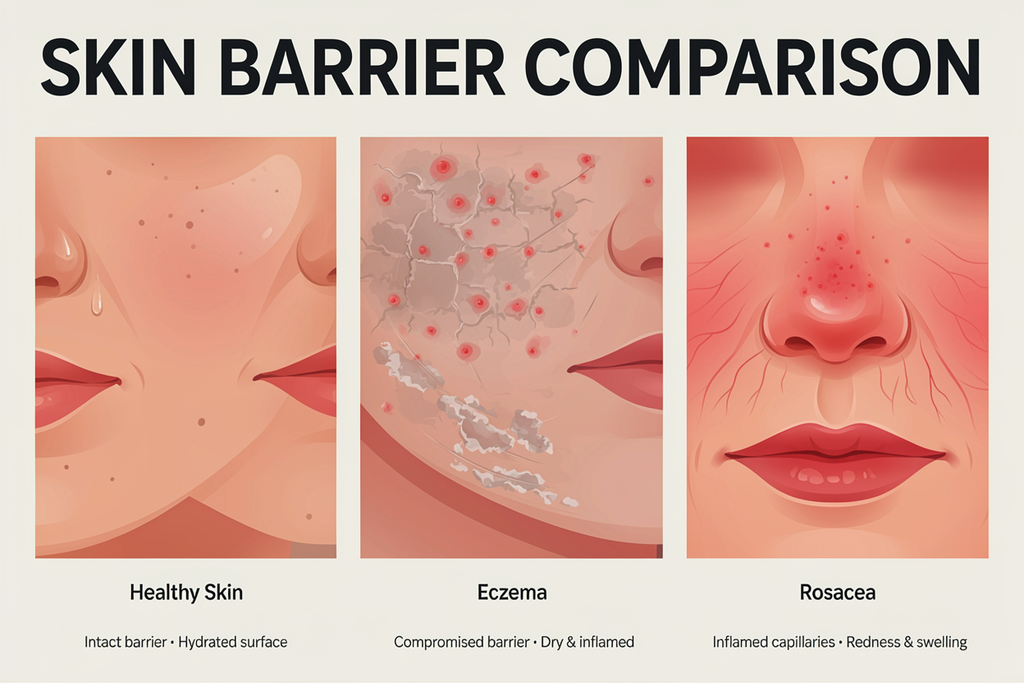
A person with eczema may have a barrier defect that lets more water escape and irritants enter. A person with rosacea may have increased facial permeability alongside inflammation, burning, flushing, and sensitivity. Research has found measurable barrier abnormalities in both conditions.
This article looks at what that means without treating eczema and rosacea as the same disease.
Not medical advice: This article is for general health education. Eczema, rosacea, contact dermatitis, acne, and other skin conditions can look similar, so a dermatologist should diagnose persistent, worsening, or unexplained symptoms.

Why can a weak skin barrier make eczema or rosacea feel worse?
Skin Barrier and Eczema/Rosacea starts with a simple change: the outer layer of skin becomes less effective at controlling what leaves and enters the skin. Water can escape more readily, while irritants may have an easier path into the tissue. That can increase dryness, sensitivity, burning, itching, or inflammation, depending on the underlying condition.
The barrier is not a single substance. The outermost part of the epidermis, the stratum corneum, contains corneocytes surrounded by lipids such as ceramides, cholesterol, and fatty acids. Together, these structures help regulate water movement and protect the skin from the outside environment.
One way researchers assess this function is through transepidermal water loss, commonly abbreviated as TEWL. Higher TEWL generally indicates that more water is passing through the skin.
That gives researchers something measurable instead of relying only on whether skin “looks dry.”
A study comparing people with atopic dermatitis, rosacea, and healthy skin found that lower tolerance to an irritant was associated with higher TEWL and lower stratum corneum hydration. The researchers also found an important difference between the conditions. Barrier deterioration in atopic dermatitis was detected at both tested sites, while the abnormal skin physiology in rosacea was observed on facial skin.
So a weak barrier is not simply a synonym for dehydration.
It is a change in how the skin functions.
Eczema and the barrier: why the two problems can reinforce each other
Skin Barrier and Eczema/Rosacea is particularly relevant to atopic dermatitis because barrier dysfunction and inflammation can reinforce one another.
The American Academy of Dermatology explains that the skin barrier in atopic dermatitis develops gaps that allow too much moisture to escape. The same gaps can make it easier for substances such as fragrances and other environmental exposures to interact with the skin. The AAD describes genes, the immune system, and things that touch the skin as factors that can contribute to atopic dermatitis.
Filaggrin is one of the terms that comes up repeatedly in eczema research.
Filaggrin helps the epidermis maintain its structure and contributes to natural moisturizing factors within the outer skin. Certain genetic variants affecting filaggrin can increase susceptibility to atopic dermatitis. That does not mean every person with eczema has a filaggrin mutation, nor does it mean the condition can be explained by one gene.
Eczema is more complicated than that.
The lipid composition of the stratum corneum also matters. Ceramides, cholesterol, and fatty acids form part of the structure that helps the outer skin control water movement. Research has found changes in skin lipids and barrier function in atopic dermatitis.
Then there is the itch.
This is where eczema can become especially frustrating. A compromised barrier can contribute to irritation and itching. Scratching damages the surface mechanically. More damage can mean more irritation, which can lead to more scratching.
The cycle does not require you to have consciously chosen the wrong skin-care product. Sometimes the disease itself is enough to disturb the barrier.
That is why describing eczema as “just dry skin” misses an important part of the condition.
Rosacea has a barrier problem too, but it is not eczema
Skin Barrier and Eczema/Rosacea needs a separate discussion for rosacea because the symptoms and mechanisms are not interchangeable with atopic dermatitis.
Rosacea mainly affects facial skin. Flushing, persistent facial color, burning or stinging, visible blood vessels, and acne-like bumps can occur, although not everyone experiences the same combination. The American Academy of Dermatology notes that rosacea can also be mistaken for other conditions, including eczema and seborrheic dermatitis.
That overlap explains why self-diagnosis can be unreliable.
Someone may describe their face as having a “damaged barrier” because almost every product burns. That description tells you something useful about the skin’s current sensitivity, but it does not tell you why the skin became sensitive.
Rosacea itself can be associated with barrier dysfunction.
A 2020 study published in the Journal of Investigative Dermatology examined rosacea and reported severe dryness, increased TEWL, altered skin pH, and decreased hydration among the characteristics associated with the condition. The study was authored by Barbara Medgyesi and colleagues and examined the barrier at a molecular and physiological level.
That finding aligns with what dermatologists often hear from people with rosacea: skin that burns or stings easily.
The AAD’s rosacea guidance, reviewed by board-certified dermatologists, specifically describes rosacea-prone skin as sensitive and easily irritated.
The important point is that barrier dysfunction can be part of rosacea without being the whole explanation for rosacea.
What does a flare actually tell you about your barrier?
There is no single symptom that proves your skin barrier is damaged.
Still, certain changes are worth paying attention to.
If your skin suddenly feels tight after cleansing, burns when you apply familiar products, becomes unusually rough or flaky, or reacts to products that previously caused no problem, the skin’s tolerance may have changed.
With eczema, itching and dry, irritated skin are particularly relevant. The AAD explains that the barrier changes seen in atopic dermatitis contribute to moisture loss and exposure to environmental substances.
With rosacea, burning, stinging, flushing, and persistent facial color can be more informative than dryness alone. The AAD specifically lists burning, stinging, flushing, and visible blood vessels among the signs associated with rosacea.
There is another reason not to label every red or flaky patch as “barrier damage.”
Contact dermatitis can irritate. Seborrheic dermatitis can cause scaling. Acne can coexist with redness. Perioral dermatitis can appear around the mouth and nose. Even a reaction to a newly introduced cosmetic can produce symptoms that look similar to an existing skin condition.
The appearance alone does not always tell you what is happening underneath.
Why products can suddenly start burning
This is one of the most confusing parts of Skin Barrier and Eczema/Rosacea
Imagine using the same cleanser for months without a problem. Then one morning it stings.
It is tempting to conclude that the cleanser suddenly became “bad.”
That is not necessarily what happened.
A change in the skin can alter how comfortably it tolerates the same product. Research connecting barrier function with irritant thresholds supports this idea. In the study of atopic dermatitis and rosacea mentioned earlier, people with higher TEWL and lower stratum corneum hydration had lower irritant thresholds.
The product did not necessarily change.
The skin may have.
This also explains why adding more products can sometimes make the situation harder to understand. If you introduce a new cleanser, serum, exfoliant, mask, and moisturizer during the same week, you have little way of knowing which change helped or which one caused more irritation.
For someone already dealing with eczema or rosacea, that uncertainty matters.
The ingredients that make up the barrier
The phrase “skin barrier” can sound like marketing language until you look at what it actually contains.
Ceramides are lipids found naturally in the stratum corneum. Cholesterol and fatty acids are also important components of the lipid matrix between corneocytes.
Water-binding substances within the outer skin contribute to hydration. Occlusive materials can reduce the amount of water that escapes from the surface. Emollients can improve the feel and flexibility of dry skin.
These categories are different.
A humectant does not work in the same way as an occlusive. A moisturizer is not a single ingredient. It is a formulation made from several components that can affect how the product feels and behaves on the skin.
That is one reason dermatologists do not describe moisturizer selection as a universal formula.
Rebecca Kazin, MD, FAAD, a board-certified dermatologist quoted by the American Academy of Dermatology, explains that there is not one moisturizer type that suits every skin type. The AAD distinguishes among lotions, creams, gels, and ointments because their textures and oil-water compositions differ.
For someone with sensitive facial skin, tolerance matters as much as the ingredient list.
A theoretically useful ingredient does not guarantee that an entire formula will feel comfortable.
Why “barrier repair” does not diagnose the condition
Skin Barrier and Eczema/Rosacea can easily become misleading if every symptom is blamed on barrier damage.
A person can have a compromised barrier because of an inflammatory skin condition.
A person can also irritate otherwise healthy skin through excessive cleansing, repeated exfoliation, friction, or exposure to something their skin does not tolerate.
Those are different situations.
The distinction becomes especially important with rosacea because the condition can resemble several other facial disorders. The AAD recommends dermatological assessment because rosacea can be confused with conditions such as lupus, eczema, and seborrheic dermatitis.
The same principle applies to eczema. Persistent itching, redness, scaling, or recurrent flares deserve more than repeated experimentation with cosmetic products.
A barrier cream may make dry skin feel better. That does not establish why the skin became dry or irritated in the first place.
What can quietly keep a weak barrier irritated?
Sometimes the biggest problem is not one dramatic ingredient.
It is repetition.
A person might cleanse aggressively in the morning, use an exfoliating acid at night, scrub flaky areas when they become rough, and then add a new serum because the skin still feels uneven. Each step may seem reasonable in isolation.
Together, they may be too much for already irritated skin.
The AAD’s rosacea guidance recommends avoiding rubbing, scrubbing, facial sponges, exfoliators, and other practices that irritate sensitive facial skin. It also recommends fragrance-free products rather than products simply labeled “unscented.”
For rosacea, sun exposure is another well-established concern. The AAD identifies sunlight as a common trigger for flare-ups and recommends broad-spectrum SPF 30 or higher along with other sun-protection measures.
Eczema has its own collection of triggers, which can vary considerably between individuals.
That is why copying someone else’s “barrier repair routine” from social media can be less useful than figuring out what repeatedly irritates your own skin.
Eczema and rosacea should not be managed as identical “sensitive skin”
This is probably the most useful distinction to keep between Skin Barrier and Eczema/Rosacea
Both conditions can involve impaired barrier function.
Both can make skin feel uncomfortable.
Both can react badly to irritating products.
But eczema is an inflammatory disease with a strong relationship between epidermal barrier dysfunction and immune activity. Rosacea is a chronic inflammatory facial disorder with its own vascular, neural, immune, and barrier-related features.
Research supports measurable barrier abnormalities in both conditions, but it also shows differences between them. The study of TEWL and irritant thresholds found generalized barrier abnormalities in atopic dermatitis, while the rosacea group showed impaired skin physiology on the face.
That distinction is easy to lose when “damaged skin barrier” becomes a popular social-media explanation for every skin problem.
Your skin can be irritated without the underlying cause being the same as someone else’s.
When recurring symptoms deserve a dermatologist’s attention
A one-off episode of dryness after cold weather is different from skin that repeatedly burns, itches, flushes, cracks, or develops unexplained redness.
If symptoms keep returning, spread, interfere with daily life, affect the eyes, or do not make sense based on your usual skin pattern, professional assessment becomes more useful than continuing to rotate through products.
Rosacea is diagnosed clinically by examining the skin and, when necessary, checking for other conditions that can look similar. The AAD specifically recommends seeing a board-certified dermatologist for diagnosis.
That matters for eczema too. Treatment depends on what is actually causing the inflammation, not simply on whether the surface feels dry.
A good skin-barrier discussion should therefore end at the right place.
Not every flare needs another serum.
Sometimes it needs a diagnosis.
FAQs
Can a weak skin barrier cause eczema?
A weak barrier is closely involved in atopic dermatitis, but saying that barrier weakness alone “causes” eczema oversimplifies the disease. Genes, immune responses, environmental exposures, and skin-barrier changes can interact in atopic dermatitis.
Can rosacea damage the skin barrier?
Research has found impaired barrier function in people with rosacea, including increased TEWL and reduced hydration. A 2020 Journal of Investigative Dermatology study described markedly diminished barrier characteristics in rosacea.
Why does my moisturizer suddenly sting?
A product that previously felt comfortable may sting when the skin becomes more irritated or the barrier becomes less effective. Research has found a relationship between lower irritant tolerance and higher TEWL in people with atopic dermatitis and rosacea.
Is redness always a sign of a damaged skin barrier?
No. Redness can occur with rosacea, eczema, contact dermatitis, acne, infection, and other conditions. Rosacea itself can also resemble other facial disorders, which is one reason the AAD recommends professional diagnosis when rosacea is suspected.
Can skin-barrier care replace treatment for eczema or rosacea?
Barrier-supportive skin care can be part of managing these conditions, but it does not establish a diagnosis or address every mechanism involved in eczema or rosacea. A dermatologist can determine whether the symptoms represent eczema, rosacea, contact dermatitis, or another condition.
How do I know whether my skin barrier is actually damaged?
There is no reliable home symptom checklist that can confirm barrier damage. Increased dryness, tightness, burning, stinging, irritation, or changes in product tolerance can occur when barrier function is impaired, but those symptoms can have several causes. Persistent or recurrent symptoms should be assessed by a dermatologist.