
Do Spicules Really Boost Collagen? What Studies Actually Show
Every spicule serum on the market says some version of the same thing: that these microscopic needles “stimulate collagen production.” You’ve probably read that line a dozen times and never once seen it point to an actual study. So let’s fix that.
This piece pulls the real research, the papers that actually measured something in real skin, and walks through what they found, what they didn’t test, and where the honest answer to do spicules boost collagen actually lands. Spoiler: the science is more specific, and more interesting, than the marketing copy lets on.
Do Spicules Really Boost Collagen?
The honest answer is a qualified yes, with an asterisk. The strongest peer-reviewed evidence for spicules improving dermal depth and density comes from a 2017 study pairing spicules with epidermal growth factor, not spicules used alone. Plain, unadorned spicule serums haven’t been tested in a controlled human trial that isolates collagen synthesis as the outcome. The mechanism is plausible. Direct proof of the standalone effect is still thin.
That’s not a dodge. It’s the actual state of the research, and it’s worth walking through study by study, because the difference matters more than it sounds like it should.
What Proving “Boosts Collagen” Actually Requires
Before getting into the papers themselves, it helps to know what a real answer to do spicules boost collagen actually needs behind it, because this is exactly where most spicule marketing quietly cuts corners. A serious study measures collagen synthesis in one of a few ways. Skin biopsies stained for collagen density, the gold standard but rarely used in cosmetic research since it’s invasive.
Ultrasound measurement of dermal depth and density, a solid, non-invasive proxy that tracks structural change over weeks. Or, in a lab setting, direct measurement of type I procollagen secretion from fibroblast cell cultures, which shows the biological signal at the source but doesn’t confirm what happens in a living person’s face.
Most of what gets called “clinically proven” in spicule marketing is none of these. It’s a tingling sensation and an assumption, dressed up as evidence.
The Study Everyone Points To, and What It Actually Tested
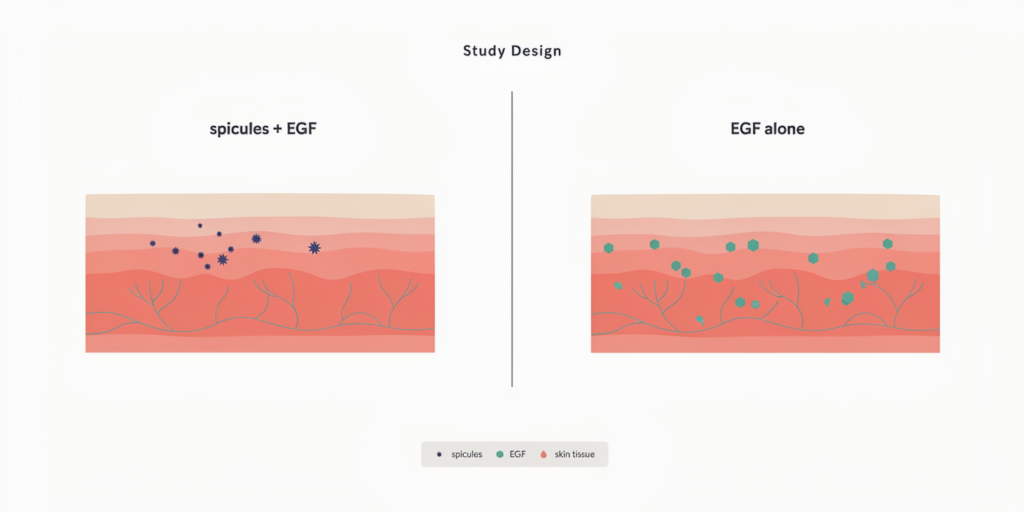
Search for research behind spicule collagen claims and you’ll eventually land on a 2017 paper in Annals of Dermatology by Ha and colleagues, tracked in PubMed under PMID 28392646. Twenty women, ages 33 to 54, went through a randomized, controlled, split-face trial. One side of the face was treated with a cream containing microspheres carrying epidermal growth factor. The other side got EGF alone, no spicules.
After four weeks of daily use and eight weeks of follow-up, the spicule side showed a statistically significant increase in dermal depth and density, measured by ultrasound, compared to the EGF-only side.
That’s a real, measured result. It’s also not quite what most people assume it is. The spicules used in this study weren’t the silica or calcium carbonate structures pulled from freshwater sponges that show up in most K-beauty spicule serums.
They were synthetic, hyaluronic acid-based pyramidal microneedles, roughly 250 micrometers in length, functioning more like a dissolving microneedle patch than a sponge-derived spicule. And the comparison wasn’t spicules versus nothing.
It was spicules plus a known collagen-stimulating growth factor versus that same growth factor without the delivery boost. The finding proves spicules improved EGF’s ability to reach the dermis and do its job better. It doesn’t prove spicules alone, without EGF riding along, do the same thing.
The Study That Actually Used Real Sponge Spicules
For evidence involving the actual marine sponge-derived spicules used in most commercial serums, the most relevant recent research is a 2025 study in the International Journal of Molecular Sciences, testing marine sponge spicules coated with a nanoencapsulated Wharton’s Jelly mesenchymal stem cell secretome.
In lab testing, treated fibroblasts showed increased type I procollagen secretion, along with faster keratinocyte migration and improved wound closure. A follow-up clinical portion tracked dermal absorption, texture, wrinkles, and pigmentation in human participants after topical use.
Two caveats matter here, and a fair piece has to name them. First, the clinical portion was a single-arm study, meaning every participant received the treatment with no separate control group to compare against, which is a real limitation on how strongly the human-level results can be interpreted.
Second, like the 2017 paper, this research tested spicules working alongside a specific bioactive payload, in this case a stem cell secretome, not spicules by themselves with nothing else attached. The procollagen increase measured in the lab is a genuinely strong data point. It’s a property of the coated system being tested, not proof that any spicule serum on a drugstore shelf produces the same effect.
Red Flags Worth Spotting in Collagen Marketing Claims
Once you know what real evidence looks like, the marketing gaps get easier to spot. A few patterns show up constantly on spicule product pages and are worth flagging directly, since they’re exactly how the do spicules boost collagen question gets muddied for shoppers.
- A vague reference to “studies show” with no journal name, author, or year attached. If a brand can’t name the paper, there’s a good chance it’s citing a general mechanism rather than an actual test of their specific formula.
- A percentage improvement figure with no source, or one attributed to the wrong study entirely. This happens more than you’d expect, including a widely repeated absorption figure that got misattributed to a study that never reported it.
- Photos labeled “before and after 4 weeks” with no mention of what else changed in the person’s routine during that time, no control group, and often no consistent lighting or angle to rule out simple presentation differences.
- Ingredient lists that bundle spicules with retinol, peptides, or vitamin C and then credit the entire visible improvement to the spicules specifically, when any of those other actives could plausibly be doing most of the work.
None of this means the products are useless. It means the collagen claim on the label is usually doing more work than the evidence behind it can support, and knowing that gap is what actually answers: do spicules boost collagen, honestly, rather than by reflex.
How This Compares to Other “Boosts Collagen” Ingredients
Spicules aren’t the only ingredient stretching a real mechanism into an oversold claim, and a little context helps here. Vitamin C has genuinely strong, decades-old research behind its role in collagen synthesis, since ascorbic acid is a required cofactor for the enzymes that build collagen molecules, a well-established biochemical fact rather than a marketing inference.
Retinoids have multiple controlled trials showing measurable dermal collagen increases after consistent use over months. Peptide claims sit closer to where spicules do: real cell-signaling mechanisms in lab settings, but much thinner human trial data once you look past the ingredient supplier’s own marketing materials.
Spicules land in reasonable company here: stronger mechanistic grounding than a lot of trending ingredients, weaker direct proof than the established heavy hitters. That’s a fair place for a relatively new cosmetic ingredient to sit, and it’s a more honest comparison than either dismissing spicules entirely or treating them as clinically proven.
Side effects of Spicule Skincare
What About Plain Spicules, With Nothing Else Added?
This is the gap nobody selling spicule serums wants to point out directly, and it’s the part of do spicules boost collagen that most reviews skip past entirely.
The most cited paper for spicule penetration mechanics, a 2022 study in the Journal of Cosmetic Dermatology by Kim and colleagues, measured how well spicules alone improved absorption of a test formula, using a Franz diffusion cell on real skin samples.
It found a genuinely strong dermal absorption rate, 73.4 percent, and confirmed the physical mechanism of channel formation through the stratum corneum. What it did not measure was collagen synthesis, dermal density, or any wrinkle or firmness outcome.
It’s a penetration study, not a collagen study, and it gets misquoted as evidence of a collagen boost more often than any other paper in this space.
Put plainly, there isn’t currently a published, controlled human trial testing plain spicules, with no growth factor, no secretome, no other bioactive attached, against a true no-treatment control, measuring collagen synthesis as the primary outcome. That specific experiment hasn’t been run yet, at least not in anything indexed and peer-reviewed as of this writing.
What the Broader Microneedling Research Adds to the Picture
Stepping back from spicules specifically, the mechanism they rely on- controlled micro-injury triggering a wound-healing cascade that includes fibroblast activation- is well documented in the broader microneedling literature. Alster and Graham’s 2018 review in Dermatologic Surgery covers this extensively across acne scarring, wrinkle reduction, and skin laxity, and the collagen induction effect at dermal depths, generally 0.5 millimeters and beyond, is genuinely well established at this point.
The catch is depth. Spicules, at their typical 100 to 300 micrometer range, mostly stay within the epidermis, above where fibroblasts actually live and produce collagen. The mechanism that makes microneedling’s collagen claims credible depends on reaching tissue that plain spicules, by design, usually don’t reach. That’s not a knock on spicules. It’s a reason to expect a smaller, more delivery-driven effect rather than the dermal remodeling deeper devices can achieve.
Do Spicules Boost Collagen? Here’s the Honest Answer
Piecing together what’s actually been measured: spicules paired with a known collagen-stimulating ingredient, whether that’s EGF or a stem cell secretome, do show a real, measured increase in dermal depth, density, or procollagen secretion in the studies that have tested them that way. Spicules used alone, with nothing added, have solid evidence of boosting absorption and creating the physical microchannels that enable delivery, but no published controlled trial yet isolates a standalone collagen effect from spicules.
The most accurate claim a spicule serum could honestly make is that it helps other collagen-supporting ingredients work harder, not that the spicules themselves are the active collagen-building ingredient. That’s a real benefit. It’s just a different one than most labels imply.
What Would Actually Settle This
A trial that would genuinely answer this question doesn’t look complicated to design; it just hasn’t been prioritized yet, likely because most spicule products are formulated with other actives anyway. It would need a randomized, controlled, split-face or split-body design: one side treated with plain spicules and an inert base, the other with the inert base alone, tracked over at least eight to twelve weeks using ultrasound dermal density measurement or biopsy-confirmed collagen staining, with a large enough group to reach statistical significance. Until something like that gets published, the honest position is that spicules likely contribute to collagen support indirectly, by improving the delivery of ingredients that do the work directly, rather than driving it on their own.
Frequently Asked Questions
Is there any proof spicules increase collagen on their own?
Not from a controlled human trial isolating spicules alone as the variable. The clearest collagen-related results come from studies pairing spicules with EGF or a stem cell secretome, not from spicules used without any added active ingredient.
Why do dermatologists say spicules stimulate collagen if the proof is incomplete?
This is the exact tension at the center of do spicules boost collagen as a question. The underlying mechanism, micro-injury triggering a wound-healing response, is well established from microneedling research, so it’s a reasonable, mechanistically grounded statement. It’s a prediction based on solid biology, though, not a citation to a study that measured plain spicules producing that exact outcome.
Do more expensive spicule serums have better collagen evidence behind them?
Not necessarily. Price usually reflects concentration, purity, and the other active ingredients in the formula rather than the existence of a dedicated collagen study. A high price tag doesn’t mean a brand has published or funded the research to back a collagen claim specifically.
How long would it take to see a real collagen effect from spicules?
Based on the closest available data, the 2017 EGF study showed measurable change at four weeks with continued improvement through eight weeks. That timeline applies to spicules paired with an active ingredient, not necessarily to spicules used alone.
Should I stop using spicule serums if the collagen claim isn’t fully proven?
Not necessarily. The absorption and texture benefits are genuinely well supported, even without a settled collagen answer. Just treat the collagen claim as plausible and partially supported rather than settled science, and don’t expect the same dermal remodeling a professional microneedling series can produce.
Conclusion
Do spicules boost collagen? The honest, sourced answer is that spicules paired with an active ingredient show real, measured collagen-related changes in the two best available studies, while spicules used alone still have a mechanism that makes sense but no dedicated trial proving the effect in isolation. That’s a more useful answer than a bottle promising renewal, and it’s the kind of distinction worth knowing before you decide what a serum can realistically do for your skin.
Want the full mechanical breakdown behind how spicules create that delivery channel in the first place? Our companion piece on how spicules work walks through the exact process these studies are measuring.