
How Do Spicules Work? The Skin Penetration Science
You’ve read the phrase “micro-channels” about ten times now, and it still hasn’t told you the thing you actually want to know: how do spicules work, mechanically, once they’re sitting on your skin? Most articles stop right at the marketing line and call it a day. This one keeps going. You’re getting the real, layer-by-layer breakdown, pulled from the actual peer-reviewed research on spicule penetration, including the specific numbers researchers measured when they tracked spicules moving through real skin samples.
How Do Spicules Work?
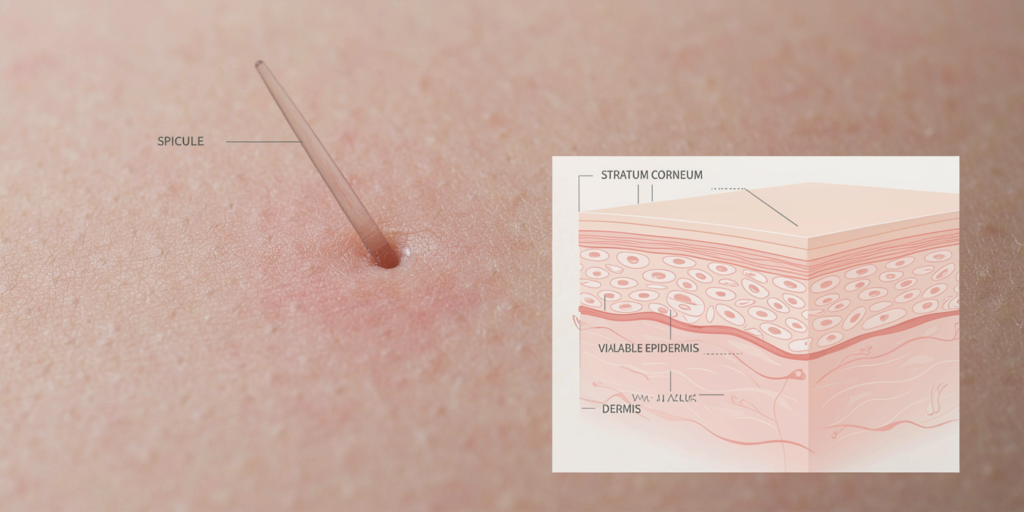
Spicules work by physically piercing the stratum corneum, your skin’s outermost layer, and opening temporary microscopic channels through it. A 2022 study in the Journal of Cosmetic Dermatology measured spicules at roughly 250 micrometers long, thin enough to breach the surface without pain, and clocked a dermal absorption rate of 73.4 percent in formulas that used them, well above what the same formula managed without spicules in the mix.
That one number carries most of this article’s weight, so let’s actually unpack it instead of leaving it hanging.
What a Spicule Actually Is, Structurally
A spicule is a rigid, needle-shaped skeletal structure, usually pulled from freshwater sponges in the Spongillidae family, occasionally from marine sponges or coral. Structurally, it’s made of biogenic silica, or in some species calcium carbonate, the same mineral class that gives sponges their internal scaffolding out in the wild. Look at a purified one under a microscope, and it doesn’t read as a blade so much as a tapered rod, pointed at one or sometimes both ends, with a surface that’s slightly porous rather than smooth, which is what lets it grip tissue instead of skidding right off it. That shape is really where the answer to how do spicules work starts, because geometry decides most of the outcome before a single active ingredient even enters the picture.
Size is where things actually vary. Between manufacturer specs and published research, most cosmetic-grade spicules land somewhere between 100 and 300 micrometers long and 10 to 25 micrometers across, and that range isn’t random. The Kim et al. study characterized its spicules at an average of 250 micrometers in length and 12 micrometers in diameter, sized deliberately so they’d clear the stratum corneum without going deep enough to draw blood or require anesthesia. Long enough to breach the barrier, short enough to stay superficial. That’s the whole engineering logic behind how do spicules work at the most basic level.
The Skin Layers Spicules Actually Reach
Here’s the part that helps a lot of this click into place: skin isn’t one wall; it’s several stacked ones. To really understand how spicules work once they’re on your face, you need to know what they’re pushing through. The epidermis, the outer layer spicules interact with, has its own sub-layers: the stratum corneum sitting right on top, made almost entirely of dead, flattened cells and lipids; then the stratum granulosum beneath that, then the stratum spinosum below that, where living keratinocytes are still actively dividing; and finally the stratum basale at the very bottom of the epidermis, right above the dermis.
Shorter spicules, in the 100-micrometer range, tend to stay put in the stratum corneum, which is already enough to loosen and lift dead cells and crack open a shallow channel for a serum to travel through. Step up to 200 micrometers, and you’re reaching the stratum spinosum, closer to living, metabolically active cells. Push toward 300 micrometers, and you can reach the stratum basale, the deepest point in the epidermis, without ever crossing into the dermis itself. None of this touches the dermis in a properly formulated product, which is exactly why spicules don’t need numbing, don’t draw blood, and don’t come with the recovery time of an in-office procedure. Knowing which layer a given product’s spicules can realistically reach is honestly the clearest way to judge how spicules work for whatever you’re specifically trying to fix, whether that’s surface texture or something happening deeper in the epidermis.
What Actually Happens, Step by Step
So here’s how spicules work in practical terms, walked through from the moment you press a serum into your skin to the moment those channels seal back up.
It starts with contact and anchoring. The spicule’s tapered, slightly rough surface catches against the stratum corneum as you press it in, rather than skidding across the surface the way a smooth bead would.
From there it’s a mechanical breach. The pointed tip pierces the dead-cell layer, and because the structure is rigid rather than flexible, it holds its shape instead of bending away, which is really what lets it punch through instead of just scratching the surface.
Once that channel opens, whatever else rode along in the formula- hyaluronic acid, niacinamide, a peptide complex- starts moving through it. The Kim et al. team tracked this using a Franz diffusion cell, a standard lab setup for measuring how something crosses skin layers over time, and found the release pattern matched simple diffusion, lining up with both Fick’s law and the Higuchi model, the two equations pharmaceutical researchers typically use to describe how a substance leaves a matrix and travels through tissue.
Then, eventually, breakdown and clearance. Spicules aren’t built to stick around. Your skin’s own enzymes, along with its normal shedding cycle, break them down and clear them out, usually somewhere between 24 and 72 hours depending on the spicule’s size and which species it came from. Once that happens, the temporary channels close and the barrier goes back to doing its job.
Why Shape, Not Just Size, Changes How Well Spicules Work
Length by itself doesn’t answer how spicules work at the level of actual, measurable performance. A separate study in Pharmaceutics looked specifically at aspect ratio, meaning the ratio between a spicule’s length and its diameter, and found that longer, narrower spicules built more effective delivery channels than short, blunt ones of roughly the same size. A stubby spicule tends to blunt itself against the skin’s surface tension rather than piercing it cleanly, while a long, thin one concentrates force into a single point, which is basically the same physics that makes a sewing needle so much easier to push through fabric than a golf tee.
This is also why two spicule serums at similar concentrations can perform completely differently. A formula built on low-purity or irregularly shaped spicules, which tends to be the cheaper route, can underperform a formula using a smaller amount of well-sorted, high-aspect-ratio spicules, because shape is doing nearly as much of the work here as the raw material itself.
What Happens to the Ingredients Riding Along
Spicules rarely show up alone in a formula, and understanding how spicules work also means understanding what they’re actually carrying with them. Research on delivering larger, harder-to-absorb molecules- one study on peptide delivery, another on delivering small interfering RNA using sponge spicules paired with flexible liposomes- found that the channels spicules create can move molecules that would otherwise just sit on the skin’s surface indefinitely, since they’re too big to pass through intact skin on their own.
A related study out of Annals of Dermatology tested micro-spicules carrying epidermal growth factor around the periocular area, one of the more delicate zones on the face, and measured a genuine reduction in wrinkle depth with consistent use. That’s a real answer to how do spicules work outside a lab setting, since it tracked an actual clinical outcome rather than a lab-only absorption percentage.
What Actually Determines Whether a Spicule Formula Delivers
Two products can list the same ingredient on the label and still perform nothing alike, and the gap almost always comes down to three things you can’t see just by reading the box.
So how do spicules work when the label says the same thing on two different bottles but the results aren’t close? Purity is the first factor. Lower-grade extracts carry more broken fragments and irregular shapes mixed in with the properly tapered, intact ones, and a broken spicule doesn’t pierce anything; it just sits there as dead weight. High-purity extracts, the kind referenced in the Kim et al. research, get sorted specifically to strip that debris out before formulation even starts.
Concentration is the second, and it’s where a lot of budget products quietly cut corners. A serum with too few functional spicules per application is essentially asking a handful of needles to do the job of thousands, and the absorption boost researchers actually measured assumes a formulation dense enough to create real channel coverage across the treated area, not a token sprinkle.
Carrier formulation is the third, and it’s the one most people never think about. Spicules build the pathway, sure, but what they’re suspended in decides what actually travels through it once it’s open. A heavy, occlusive base can trap spicules near the surface and blunt the whole effect, while a thinner, water-based carrier lets both the spicule and the active ingredient reach that channel more efficiently. This is exactly why understanding how do spicules work matters for shopping decisions, not just curiosity. Reading past the word spicule on a label, and actually checking what it’s suspended in, tells you more about real-world performance than the marketing copy ever will.
What the Research Still Doesn’t Answer
Worth being straightforward about the limits here. Most of the penetration data floating around, including the Franz diffusion cell measurements and the aspect ratio findings, comes from ex vivo studies, meaning skin samples tested outside a living body, usually porcine skin, which behaves a lot like human skin but isn’t a perfect stand-in for it. Long-term studies tracking real results across different skin tones, ages, and barrier conditions over months of actual use are still fairly thin compared to how heavily this ingredient gets marketed right now. None of that undercuts how do spicules work at the mechanical level, which is well established at this point, but it’s a fair gap to keep in mind before assuming every clinical-sounding percentage on a product page will translate exactly onto your own face.
Spicules vs. Microneedling: Same Idea, Different Depth
Lining up how do spicules work against a microneedling device is probably the fastest way to understand the ceiling on what a serum alone can do. Both rely on the same underlying idea, physically opening the skin to boost absorption and set off a repair response, and the real difference comes down to control and depth. A microneedling device, whether it’s sitting in a dermatologist’s office or it’s a roller you bought online, gets set to a fixed depth by whoever’s operating it, and it can reach into the dermis, where the collagen-producing fibroblasts actually live. Spicules, by design, stop at the epidermis. That makes them gentler and far more forgiving for home use, though it also means the collagen response they trigger runs smaller than what a properly done microneedling session can pull off. Neither one is a weaker version of the other. They’re just built for different depths and different appetites for risk.
How Do Spicules Work Differently in a Serum vs. a Patch?
The mechanism doesn’t change across formats, but the delivery window does, and that’s worth knowing before you pick one over the other. In a leave-on serum, spicules sit against your skin for hours, usually overnight, which gives the channels time to stay open and lets whatever active ingredient came along keep diffusing through for as long as the product stays in contact with skin. A hydrocolloid patch runs on a shorter, more concentrated timeline, typically 4 to 8 hours, with the adhesive applying steady pressure that helps the spicules stay anchored over a small, targeted spot, which is basically why patches get marketed for single blemishes instead of full-face use.
Neither format changes how do spicules work at the cellular level. What changes is exposure time and surface area, which happens to be the same variable that controls dosage in almost every topical delivery system out there, spicule-based or not.
Frequently Asked Questions
How do spicules work if my skin already has a strong barrier?
Resilient, well-hydrated skin generally handles the mechanical disruption better and bounces back faster, since barrier strength directly affects how quickly those microchannels reseal and how much irritation shows up along the way.
How deep do spicules actually go into the skin?
Cosmetic-grade spicules typically reach 100 to 300 micrometers into the epidermis, staying within the stratum corneum, stratum granulosum, or stratum spinosum depending on their length, and stopping short of the dermis.
Do spicules work on all skin, or only certain skin types?
The mechanism itself works on more or less any skin, since it’s a physical process rather than a chemical one, but inflamed, broken, or barrier-compromised skin tolerates that mechanical disruption far worse than skin that’s calm and resilient.
How long does it take for spicules to stop working after application?
Based on published research and manufacturer testing, spicules break down and clear from the skin within the 24- to 72-hour range, depending on their size and the sponge species they came from.
Is the tingling sensation proof that spicules are working?
A brief tingling or prickly feeling during application does line up with the microchannel formation researchers have documented, so it’s a reasonable indicator, though skipping the tingle doesn’t automatically mean you’ve got a weaker product.
Can spicules deliver ingredients that regular serums can’t?
Yes, within reason. Studies on spicule-based delivery of bigger molecules, including peptides and RNA-based ingredients, found meaningfully higher absorption than the same molecules applied without a delivery-enhancing channel, since size is usually the biggest thing standing between an ingredient and actual absorption.
Conclusion
How do spicules work, boiled down to one sentence: a rigid, microscopic needle breaches the dead-cell surface of your skin, holds a channel open just long enough for other ingredients to move through it, then dissolves before it ever gets near living tissue below the epidermis. That’s not a marketing line; it’s what Franz diffusion cell studies, aspect ratio research, and clinical delivery trials have independently measured, over and over. The mechanism holds up; it’s well-documented, and knowing exactly how it works is what really separates a smart purchase from a gamble on whatever’s trending this month.
Want the practical side of all this- what to actually buy, how often to use it, who should skip it entirely? Our companion guide on spicules in skincare picks up right where this article’s science leaves off.