
Is Spicule Skincare Safe for Sensitive Skin, Acne, or Rosacea?
For rosacea-prone skin, most dermatologists say to wait. Here’s why spicules are riskier for reactive skin types than the marketing suggests.
You’ve seen the tingling serum videos, and now you’re staring at a spicule product, wondering whether your reactive cheeks, breakout-prone jaw, or rosacea flush can handle it. Most articles on this topic lump “sensitive skin, acne, and rosacea” into one paragraph and tell you to be careful. That answer isn’t enough when the three conditions behave completely differently under a mechanical exfoliant. This guide breaks the safety question apart by condition, walks through what spicules physically do to skin, and gives you a patch-test protocol you can actually follow before you spend money on a bottle you might not be able to use. If you’re brand new to the ingredient itself, our primer on what spicules are and how they work in skincare is a good starting point before you come back here for the safety specifics.
Is Spicule Skincare Safe for Sensitive Skin, Acne, or Rosacea?
Spicule skincare isn’t equally safe for all three groups. Calm, non-inflamed acne-prone skin can often tolerate a low-concentration serum introduced slowly. Sensitive skin without active irritation can try a patch-tested product cautiously. Rosacea is different: dermatologists and the National Rosacea Society advise avoiding spicules and similar mechanical exfoliants entirely, since they worsen the vascular reactivity rosacea already involves.
What Spicules Actually Do to Your Skin Barrier
Spicules come from the mineral skeleton of marine sponges, most commonly a genus called Haliclona. Once purified, these microscopic structures look like tiny glass needles under magnification. Skincare brands suspend them in serums, gels, or single-use ampoules, and when you massage the product into your face, the spicules puncture the outermost layer of skin, the stratum corneum, at a shallow depth. If you want the full mechanical breakdown before deciding whether any of this applies to your skin, our deep dive into how spicules penetrate skin walks through the process in more depth than we have room for here.
That depth matters more than most marketing pages let on.
How deep spicules actually go
Clinical documentation on sponge-derived spicules describes penetration in the range of 0.1 to 0.3 millimeters, deep enough to create a genuine microchannel but shallow enough to avoid bleeding or the collagen remodeling that professional microneedling triggers at 0.5 millimeters and beyond. Research indexed by the National Institutes of Health on sponge Haliclona spicules found that topical application can generate over 1,000 microchannels per square millimeter of treated skin, dramatically increasing how much of an active ingredient reaches the epidermis. The spicules themselves are not biodegradable. They sit inside the skin until your natural cell turnover pushes them out, a process that typically takes four to six weeks.
That timeline is the part most product pages skip. A spicule isn’t a rinse-off exfoliant that leaves your face the moment you wash it. It’s a physical object lodged in your skin for over a month, which is exactly why the state of your skin barrier at the time of application decides how your face reacts.
Why the tingling sensation isn’t the same for everyone
Brands market the prickling feeling after application as proof the product is working. For skin with an intact barrier, that sensation is usually just the spicules forming their microchannels, and it fades within an hour. For skin that’s already inflamed, dehydrated, or actively flaring, the same mechanical disruption reads as an injury signal, and the tingling can turn into burning, visible redness that lasts for days, or a flare of whatever condition you were already managing. Dermatologists interviewed by Tira Beauty on the topic put it directly: excessive irritation from a spicule product damages the barrier rather than improving it, so burning is a stop signal, not a sign of progress.
Sensitive Skin: Where the Line Actually Sits
“Sensitive skin” isn’t one condition, and that’s exactly why blanket advice fails people who ask this question. There’s a meaningful difference between skin that’s naturally thinner or more reactive to fragrance and texture, and skin that’s currently compromised from over-exfoliation, sunburn, retinoid use, or a recently completed in-office procedure.
If your skin fits the first category and shows no active irritation right now, a low-concentration spicule product, patch-tested first, is a reasonable experiment. Rael’s clinically tested serums, for example, pair a low percentage of azelaic acid-coated spicules with soothing actives like allantoin and ectoin specifically to reduce the odds of a reaction in sensitive users. That formulation choice matters. A bare spicule serum with no buffering ingredients behaves very differently on reactive skin than one built with barrier support in mind.
If your skin fits the second category, meaning it currently stings from your regular moisturizer, feels tight after cleansing, or shows any redness that wasn’t there a month ago, wait. Adding a mechanical exfoliant on top of a barrier that’s already compromised is the single most common way people end up with a bad spicule experience, and it’s avoidable simply by timing the introduction correctly. For a full rundown of what a bad reaction actually looks like and who should sit this trend out, see our breakdown of spicule skincare side effects.
Acne: Why the Answer Isn’t the Same for Every Breakout
This is where most competing articles collapse acne into a single yes-or-no answer, and it’s the biggest gap in the existing coverage of this topic.
Acne-prone skin that is currently calm, meaning no active pustules, no open lesions, and no recent picking, can often tolerate a spicule product used as a targeted treatment on rough texture, enlarged pores, or post-inflammatory marks. The mechanism that makes spicules useful here is delivery: they create a pathway for anti-inflammatory or antibacterial actives to reach deeper into the epidermis earlier in a blemish’s life cycle, which is a genuinely different use case than “treating acne” in the way people usually mean it. It’s a different claim entirely from the anti-aging promises attached to spicules, and our look at whether spicules actually boost collagen covers why those two use cases shouldn’t be confused.
Active, inflamed, or freshly irritated acne is a different situation entirely. Applying a spicule product directly onto a raised, red pustule or a spot you’ve recently picked introduces a physical breach into skin that already has a compromised surface, and that combination raises the risk of spreading bacteria and prolonging inflammation rather than shortening it. One skincare formulator who founded a spicule-focused brand described the category as one that has to be approached responsibly precisely because the spicules are physical structures, not a chemical that simply washes away if the reaction goes wrong.
The practical rule for acne-prone skin: spicules can support texture and tone goals on skin that’s currently under control, but they are not a spot treatment for an active breakout, and they should never touch skin with an open wound.
Rosacea: Why Dermatologists Say Skip It Entirely
Rosacea gets a more direct answer than the other two categories, and it’s the one place where the research and the dermatology community are aligned without much nuance.
The American Academy of Dermatology’s guidance for rosacea management is explicit about physical exfoliation: avoid rubbing, scrubbing, facial sponges, and exfoliating tools, because anything that irritates the skin can trigger a flare. The National Rosacea Society’s own patient surveys back this up, with most respondents reporting they specifically avoid astringents and exfoliating products because they’re too harsh for rosacea-affected skin. Spicules fall squarely into the category both organizations are describing, since their entire function depends on creating a controlled injury to the stratum corneum.
Rosacea already involves a compromised barrier and heightened vascular reactivity, meaning the blood vessels near the surface of the skin dilate and inflame more easily than in skin without the condition. Introducing over a thousand microchannels per square millimeter into skin that already overreacts to heat, wind, and mild friction is not a controlled variable you want to test at home. Dermatologists quoted across multiple sources researching this trend, including specialists cited by Tira Beauty and practicing physicians writing for aesthetic clinics, consistently name active rosacea alongside eczema and open wounds as conditions where spicules should be avoided entirely rather than approached cautiously.
If you have diagnosed rosacea and you’re drawn to what spicules promise, redirect that interest toward a dermatologist-guided option instead. In-office treatments performed under sterile, controlled conditions carry a different risk profile than an at-home mechanical exfoliant you’re applying without supervision.
Ingredients That Make Spicules Riskier for Reactive Skin
The safety question isn’t only about your skin condition. It’s also about what else is already in your routine, and this is the part most guides on spicule skincare leave out entirely.
Retinoids already thin the outer layer of skin as part of how they work, which means the barrier a retinoid user brings to a spicule application is already thinner than baseline. Stack a mechanical exfoliant on top of that, and you’re compounding two different types of irritation on skin with less protection to absorb either one. The same logic applies to exfoliating acids like glycolic or salicylic acid used in the same week as a spicule product. Both mechanisms target the stratum corneum, and using them close together removes the recovery window your skin needs between each type of disruption.
If you’re currently using a retinoid or a regular acid exfoliant and you want to try spicules, the safer sequence is to pause the chemical exfoliant for several days before and after the spicule application, rather than layering all three approaches into the same week. This isn’t a reason to avoid spicules outright if your skin is otherwise calm and resilient. It’s a reason to sequence your routine so your barrier only has to recover from one kind of stress at a time.
The Patch Test Protocol Nobody’s Giving You
Most articles tell you to “patch test first” without saying what that actually looks like for a spicule product specifically, given that the spicules stay in your skin for weeks rather than rinsing off. Here’s a protocol that accounts for that timeline.
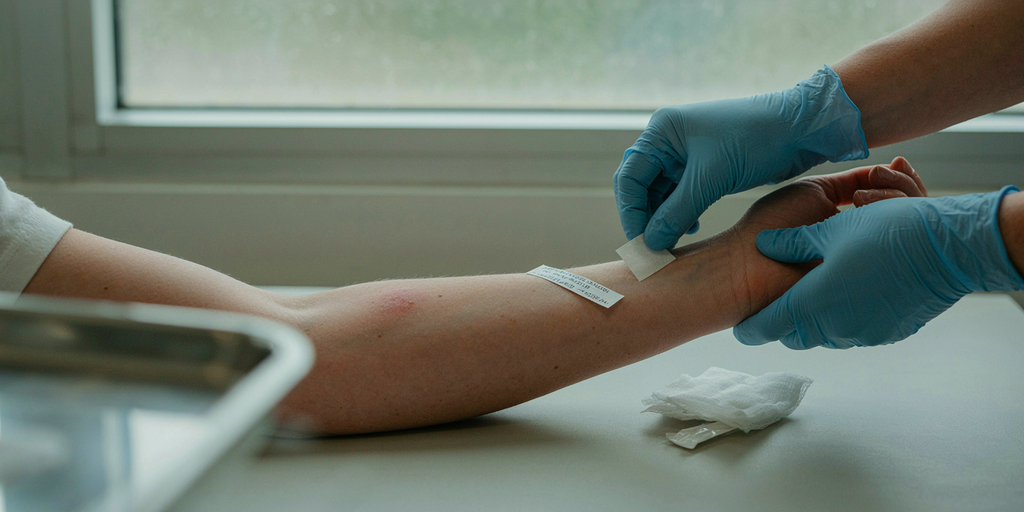
Choose a small, low-visibility test area, such as behind the ear or along the jawline, rather than the center of your face.
Apply a thin layer following the product’s instructions exactly, including the recommended contact time.
Wait 48 to 72 hours before judging the result, since delayed sensitivity from barrier stress can appear days after the tingling fades.
Watch specifically for burning that doesn’t resolve within the first hour, swelling, or redness that spreads beyond the test area.
If the area stays calm, apply to a single small facial zone next, such as one cheek, before committing to full-face use.
Space applications at least 48 hours apart even after a successful patch test, since daily use raises the risk of cumulative barrier damage.
If any stage produces burning rather than mild prickling, stop. That’s the line dermatologists draw between a product doing its job and a product doing damage.
Spicules vs Microneedling vs Chemical Exfoliants for Sensitive Skin
People with reactive skin often ask whether a gentler chemical exfoliant or professional microneedling would be the safer route, and the honest answer depends on what you’re trying to fix.
Chemical exfoliants such as low-strength lactic acid dissolve the bonds between dead skin cells without creating a physical channel, which makes the effect easier to control and to stop mid-reaction, since you can simply rinse the product off. Spicules can’t be rinsed away once applied, since they remain lodged in the skin until natural turnover clears them, which is why the margin for error is smaller.
Professional microneedling, performed by a licensed provider, penetrates far deeper than a spicule, stimulates collagen remodeling, and is done under conditions designed to manage infection risk and calibrate depth to your specific skin. For anyone with rosacea, eczema, or a currently compromised barrier, a conversation with a dermatologist about in-office options is a more predictable path than experimenting with an at-home product whose depth and concentration you can’t adjust once it’s in your skin.
For calm, resilient skin without a diagnosed inflammatory condition, spicules occupy a genuine middle position: more active than a chemical exfoliant, less invasive and less expensive than an in-office procedure. That middle position is exactly why the category has grown quickly, and exactly why it isn’t the right fit for everyone asking this question. If you’re still weighing the two options directly, our side-by-side comparison of spicules and microneedling breaks down cost, downtime, and results expectations for each.
Frequently Asked Questions
How long do spicules stay in the skin after application?
Spicules typically remain in the skin for four to six weeks, clearing gradually through your natural cell turnover cycle rather than washing off with your next cleanse.
Can I use spicule skincare if I have eczema?
Dermatologists group eczema with rosacea and active infections as conditions where spicules should be avoided, since a compromised barrier reacts to mechanical exfoliation with more inflammation rather than improvement.
Do spicules help with acne scars?
Spicules can support the appearance of textural acne scarring by improving the delivery of brightening or collagen-supporting actives into the treated area, though the effect is gradual and works best on healed, non-inflamed skin rather than active breakouts.
Is a tingling or prickling feeling normal with spicule products?
A mild, brief tingling or prickling sensation is a normal part of how spicules create microchannels in the skin, but burning, spreading redness, or a sensation that doesn’t fade within roughly an hour is a sign to stop and rinse the product off.
How often should sensitive skin use a spicule product if it’s tolerated?
Once weekly is a reasonable starting frequency for sensitive but currently calm skin, with at least 48 hours between applications to give the barrier time to recover before the next use.
Are spicules the same as microneedling?
No. Spicules penetrate roughly 0.1 to 0.3 millimeters and rely on natural shedding to clear, while professional microneedling reaches significantly deeper, stimulates collagen production, and is performed under clinical supervision
Every competitor treats “sensitive skin, acne, or rosacea” as one bucket with one blanket warning; this piece is the only one that gives each condition its own mechanism-based answer (acne calm vs. active, sensitized vs. barrier-compromised, rosacea as a hard no) plus a timeline-aware patch-test protocol built around the fact that spicules sit in skin for weeks, not seconds.